

The system knows what “homosexual” is, but refuses to protect us
Justice cannot be measured only by the existence of the law
 22/Mar/26
 2150
2150
The system knows what “homosexual” is, but refuses to protect us
Author: Ali Malikov
Translation: Minority Azerbaijan
I am angry, my community friends. There is a topic that has been bothering me in recent months. I have had the opportunity to follow several court proceedings related to queer community. But as the case of Ruzgar, who was murdered by their relative on the grounds of queerphobia, continues, a feeling does not leave me alone. I see a systematic indifference towards us in these cases.
A 19-year-old young queer person was murdered on November 6th of last year by their uncle Babak Ibadov in Bashir Safaroglu, one of the back streets of “Targovaya”. It was reported that they lived in Turkey and had only come to Azerbaijan for 10 days to renew their passport.
In the process currently being investigated by the Baku Court of Grave Crimes, familiar events and indifferences have begun to appear again. In one of the recent trials, Ruzgar’s mother I.S. said in her testimony that “I learned about my son’s death the day after the incident. I am not complaining about my brother-in-law, I have forgiven him.” In cases of murders of LGBTQI+ people in Azerbaijan, it has become a tradition for the legal heir to forgive the murderer. The brother of journalist Avaz Hafizli, whose 4th anniversary of his murder was marked last month, also announced in court that he had forgiven his cousin, Amrulla Gulaliyev, who was Avaz’s murderer. Thus, with the legal heir forgiving the accused, the criminal received a lesser sentence.
The patriarchal government apparatus of Azerbaijan and the patriarchal courts under its influence, as well as patriarchal families, continue to prevent the murderers from receiving the punishment they deserve, even in LGBTQI+ murders. According to Azerbaijani law, reconciliation between the parties in grave crimes such as murder does not terminate the criminal case. However, the courts consider this to be a mitigating circumstance. In practice, however, this mechanism can often lead to the victim’s withdrawal due to social pressure or fatigue caused by the long legal process.
During Avaz Hafizli's first trial, his mother demanded the harshest punishment for the accused, Amrulla Gulaliyev, but whatever happened, at the next hearing, the families announced a reconciliation and we never saw Avaz's mother speak in the courtroom again. In order not to see what was happening, we were not allowed into the courtroom, which could comfortably accommodate 30 people. We were prepared because we had anticipated all this. Our public surveillance and support actions for Avaz continued until the final trial in front of the Baku Court of Grave Crimes.
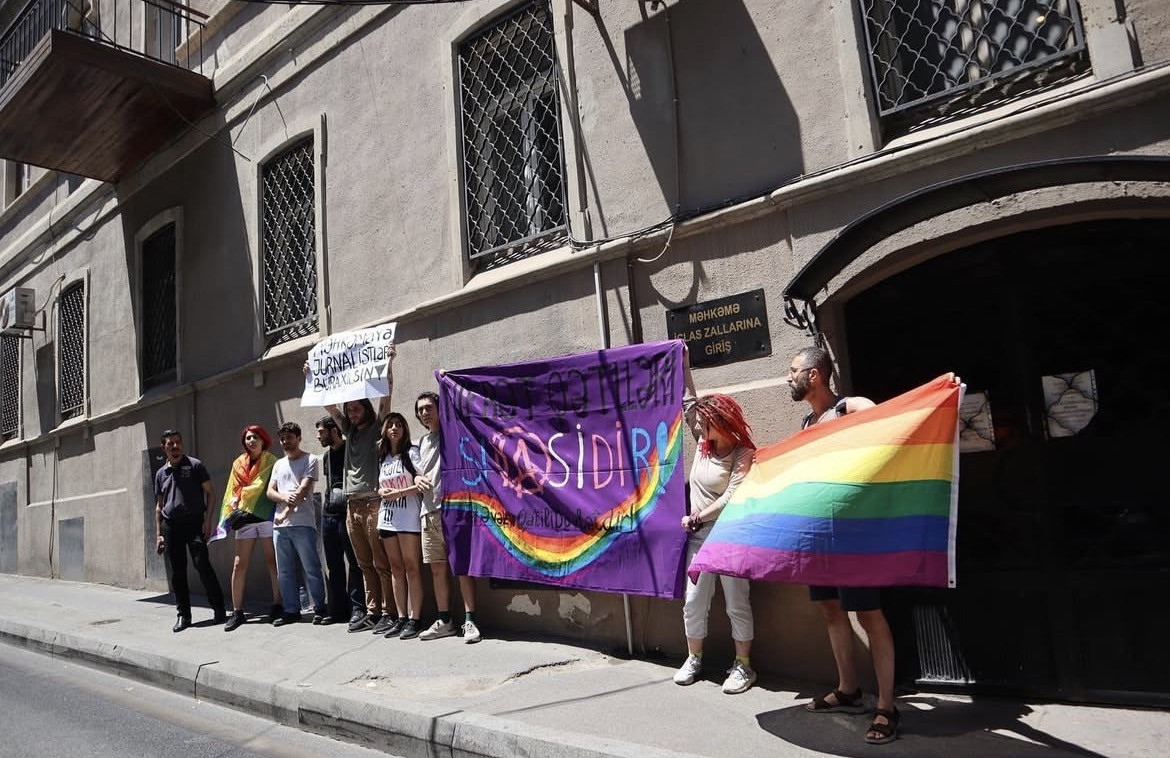
4 July, 2022
Photo: Ulviyya Ali
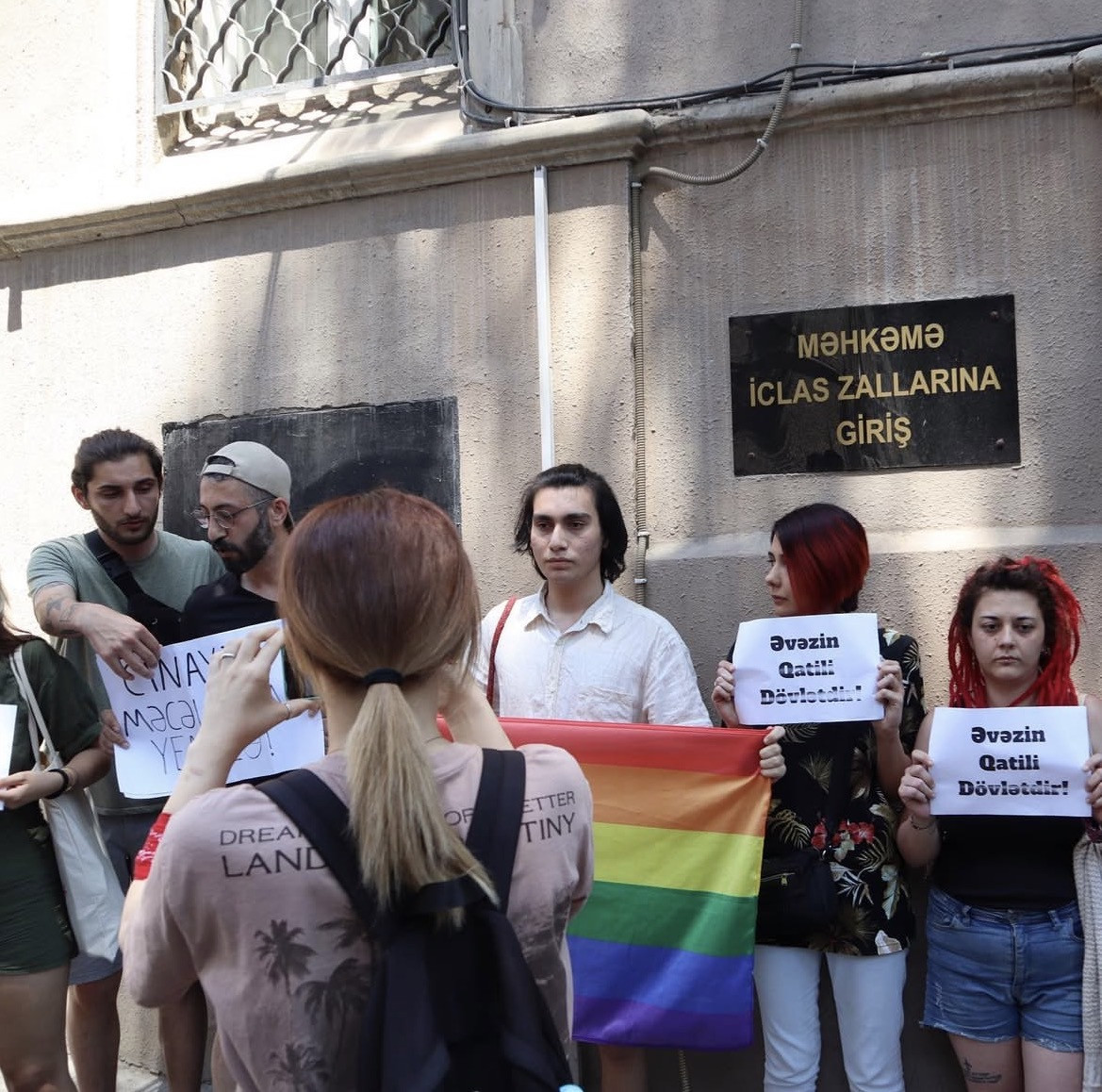
20 June, 2022
Photo: Ulviyya Ali
The failure of families to protect their children due to their identity leads to young people being left alone in difficult living conditions, homelessness, psychological problems, and in some cases, suicide attempts. Similar social mechanisms could be seen in the fate of Isa Shahmarli, who committed suicide in 2014. Vahid Aliyev wrote about the funeral of Isa Shahmarli in Minority Azerbaijan in 2020, “I will never forget the day Isa was buried, the relatives initially prevented those who came, attacked journalists and his friends. Despite all this, we were able to participate. We all watched the end of a queer fate, there was an LGBT flag on the grave. Almost all of the visitors shared the same fate as Isa.”
Patriarchal family structures, kin pressure, and social stigma are not accidental factors in these cases. In most cases, even if there are people on the victim’s side who want to defend the victim for these reasons, they are silenced. But the issue does not end there. The problem is also that the same mechanism is repeated in the legal system itself. For example, in many cases, the court ignores the identity of the victim, does not recognize the motive, and reduces the crime to the level of a personal conflict. When the need arises, that identity suddenly becomes an excuse for the criminal. In a court decision in Nakhchivan regarding the rape of a minor, the accused was noted as “suffering from homosexuality,” and this was used as a basis for mitigating the sentence.
In more sound legal systems, the interpretation and conscience of the judge can compensate for the gap in the legislation. In an environment where existing legal gaps are used as a cover-up, justice for us remains dependent on the hope of a few people.
Legal neutrality requires the consistent application of the same principle. If queer existence is selectively and wastefully included in court cases, then there can be no question of coincidence. So the system also knows what “homosexual” is, but refuses to recognize the causes of violence by citing legal classification. The repetition of similar logic in different cases is not the result of individual judicial decisions, but a tradition and a destiny brought upon us.
Ruzgar's case is not yet over, the trial is ongoing. I want to ask if you can predict the outcome of the case this time? For example, at the hearing on March 4, the defendant's lawyer filed a motion to have him undergo a psychiatric examination. Fortunately, the prosecutor asked the court not to grant it, stating that there was no basis for the motion, and the court did not grant the motion. On paper, this may seem like a normal legal procedure, but such motions are often used to prove that the defendant's mental state is problematic, to send him to a psychiatric hospital instead of a prison, or to mitigate criminal liability.
I call on all my community friends to be a voice for Ruzgar. I call on our friends, journalists, as well as the court that will make this decision, to take a responsible approach and show empathy.
Justice cannot be measured only by the existence of the law.
Do not let us suffer the same fate.
Do not leave us alone.
Powered by Froala Editor