

Azerbaijan remains 48th out of 49 European countries in Rainbow Map
Rainbow Map 2026: Azerbaijan remains 48th out of 49 European countries
 12/May/26
 2500
2500
Rainbow Map 2026: Azerbaijan remains 48th out of 49 European countries
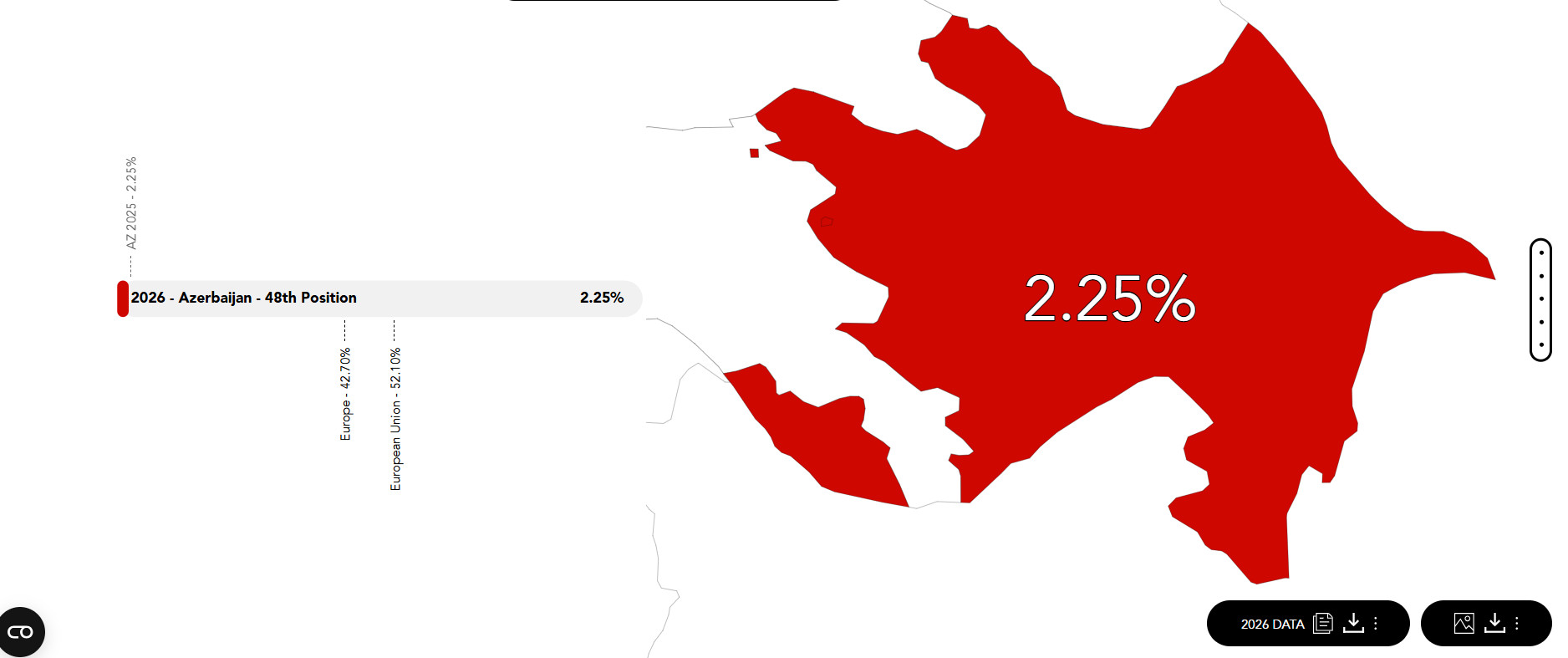
In ILGA-Europe's annual LGBTQI+ rights ranking, our country has held the same score in the second-to-last position for the third consecutive year. Since 2013, Azerbaijan's score has dropped from 7.65% to 2.25% — meaning a regression of more than threefold in terms of legislation and policy.
ILGA-Europe, the leading LGBTQI+ rights advocacy network in Europe, presented its 18th annual Rainbow Map report to the public today. In this map, which ranks 49 European countries on a 0–100% scale based on laws and policies affecting LGBTQI+ people, **Azerbaijan placed 48th with a score of 2.25%**, ahead of only Russia (49th).
The bottom five of the ranking are: 45. Armenia, 46. Belarus, 47. Türkiye, 48. Azerbaijan, 49. Russia. This means that the zones covering the South Caucasus, Eastern Europe and Anatolia continue to be the most legally dangerous region in Europe for LGBTQI+ people.
A decade-long leadership has come to an end: Spain dethroned Malta
This year, the main headline of the Rainbow Map came from the top of the list. Spain overtook Malta — which had held the lead for 10 consecutive years — and rose to first place for the first time. Spain's progress was made possible by the full implementation of the depathologisation of trans people in the healthcare system, new legal protection mechanisms, the adoption of national LGBTQI+ and trans strategies, the establishment of an independent equal-treatment and anti-discrimination body, and determined resistance against far-right attempts to dismantle national trans laws.
Completing the top five: 1. Spain, 2. Malta, 3. Iceland, 4. Belgium, 5. Denmark. The Europe-wide average is 42.70%, while the European Union (EU) average is 52.10%. Azerbaijan's 2.25% score is several times lower than these figures.
In her statement, Katrin Hugendubel, Deputy Director of ILGA-Europe, said that Spain's number-one ranking shows "what democratic leadership can look like" at a moment when authoritarianism is pressing in on Europe from both east and west, and when LGBTQI+ rights are being used as a political tool. According to Hugendubel, "political courage is a choice, and governments that make this choice can genuinely push [authoritarianism] back."
Azerbaijan: a 13-year-long decline
Azerbaijan's position on the Rainbow Map has continuously worsened over the last 13 years. The report's annual data paints the following picture:
- 2013: 7.65%
- 2014: 6.60%
- 2015: 5.00%
- 2016: 4.85%
- 2017: 4.70%
- 2018: 4.70%
- 2019: 5.67%
- 2020: 2.33%
- 2021: 2.33%
- 2022: 2.41%
- 2023: 2.41%
- 2024: 2.25%
- 2025: 2.25%
- 2026: 2.25%
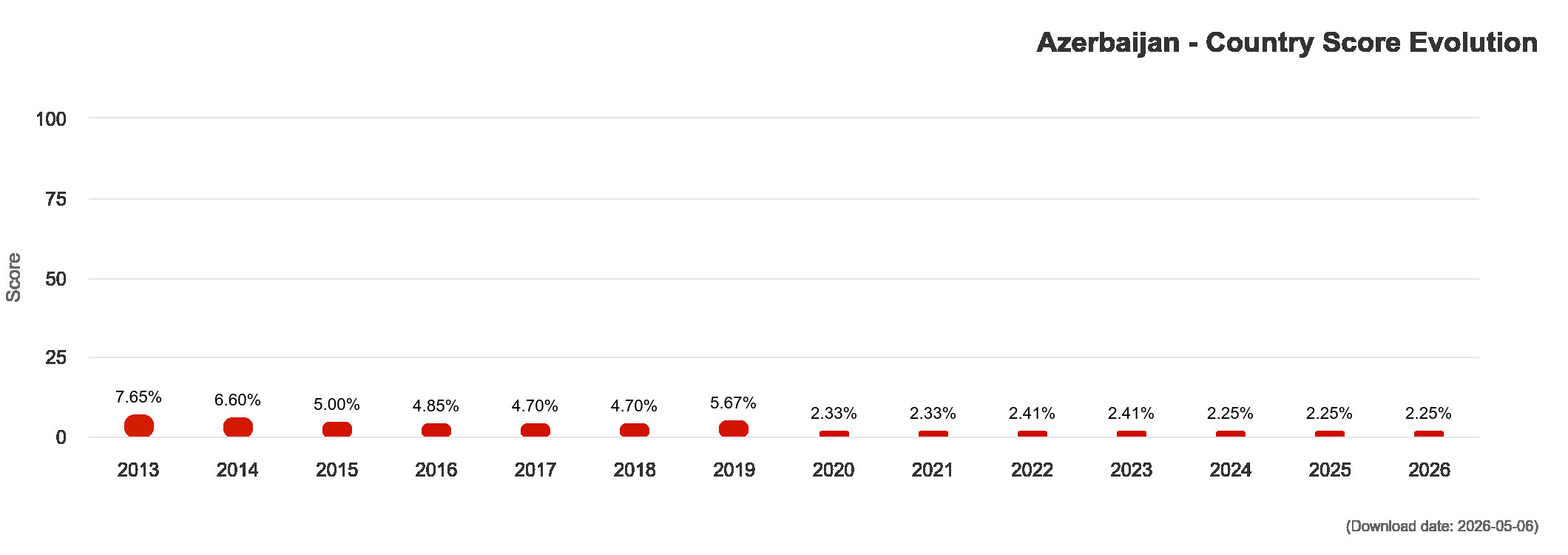
Since 2019, the country's score has dropped sharply by more than half and has not moved for three years. Both the methodology section of the report and the data collected specifically for Azerbaijan prove that no meaningful legal or administrative reform regarding LGBTQI+ people has been carried out in the country. Even the small portion of the existing score, in most cases, does not come from laws that openly protect LGBTQI+ people, but simply from the absence of certain prohibitions.
A category-by-category look at what is missing
ILGA-Europe divides its 76 criteria into 7 thematic categories. Azerbaijan's 2026 indicators are as follows:
- Equality and non-discrimination: 0.00%
- Family: 0.00%
- Hate crime and hate speech: 0.00%
- Legal gender recognition: 4.29%
- Intersex bodily integrity: 0.00%
- Civil society space: 16.67%
- Asylum: 0.00%
Azerbaijan's score is a flat zero in five out of the seven categories. This shows that no legal norm directly regulating the equality of LGBTQI+ people, their family rights, their protection from hate crimes, the bodily integrity of intersex children, or asylum rights exists in the country.
Equality and non-discrimination: 0%
There is no provision in the constitution, in labour legislation, or in the areas of goods and services, education, and healthcare that prohibits discrimination on the grounds of sexual orientation, gender identity, or sex characteristics (intersex). Mechanisms such as a ban on "conversion practices" (i.e., exploitative measures carried out under the name of "corrective therapy"), an equality body, or an equality action plan are also non-existent.
A nuance highlighted in the report concerns blood donation: although there is no explicit restriction based on sexual orientation, trans citizens cannot donate blood, because the list of diseases excluded from donation includes an entry referring to "F64 — Gender Identity Disorder" (ICD-10).
Family: 0%
Azerbaijan scored zero across the criteria for marriage equality, registered partnership (whether with rights equivalent to marriage or with limited rights), the legal recognition of cohabitation, joint adoption, second-parent adoption, automatic co-parent recognition, medically assisted insemination, and the recognition of trans parenthood.
Although Article 34 of the Constitution does not explicitly define marriage as a union between a woman and a man (this nevertheless does not allow the country to score on the "no constitutional limitation" criterion, since the required condition is the absence of any limitation), the wording of Article 34.IV — "husband and wife have equal rights" — defines this union in binary terms.
Hate crime and hate speech: 0%
There is no law that specifically punishes hate crimes or hate speech based on sexual orientation, gender identity, or gender expression. The "policy tackling hatred" required to earn points in this category also does not exist. In the field of sex characteristics, the hate crime criterion has been assessed as "not applicable."
Legal gender recognition: 4.29%
Azerbaijan receives a minimal score in this category, but the reason is not progressive legislation; it is the absence of an absolute prohibition. In other words, there is no direct legislation making legal gender recognition impossible in the country, but neither is there a clear legal and administrative procedure that makes it possible.
The report indicates that, to change their name, trans people must submit a medical report stating that they have undergone surgery. However, these procedures are "vague, inconsistent, and not guaranteed for trans people"; LGBTQI+ organisations have recorded no successful name-change case in recent years.
Although gender-affirming surgeries are not explicitly prohibited by law, there is no general regulatory framework. In 2016, a surgery was reportedly carried out legally in a private hospital with the permission of the Ministry of Health and the forensic-medical examination authorities, but such cases are handled "on an individual basis, within the framework of general medical rules." There is no score on any of the criteria for self-determination, non-binary recognition, abolishing the "gender identity disorder" diagnosis, or removing mandatory medical/surgical intervention or sterilisation.
Intersex bodily integrity: 0%
The prohibition of medical interventions on intersex children without consent, the universality of that prohibition, a monitoring mechanism, and access to justice for victims are not reflected in legislation.
Civil society space: 16.67%
This is the only category in which Azerbaijan earns a substantial score, but even so, the points obtained relate solely to the criterion concerning the absence of a specific law restricting freedom of expression at the national/local level. The report also notes that:
Freedom of assembly is severely restricted in Azerbaijan; the law on public events provides heavy fines for organisers and participants of unauthorised actions. "Due to the extremely hostile political and social environment for human rights defenders, LGBTI people do not exercise their right to freedom of assembly," ILGA-Europe stated.
Asylum: 0%
There is no separate law recognising asylum claims based on sexual orientation, gender identity, or sex characteristics. This is a serious gap, especially against the backdrop of the situation in neighbouring Russia, Türkiye and Iran — that is, in cases where LGBTI citizens of these countries view Azerbaijan as a transit point.
What is the Rainbow Map, and how is it calculated?
ILGA-Europe has published the Rainbow Map annually since 2009. This year's is the 18th edition. The map assesses 49 countries against 76 criteria; the criteria are divided into the seven thematic categories listed above, and together they make up 100% with different weightings based on international human rights standards and the priorities of the LGBTQI+ movement.
The data is collected and verified through the participation of member organisations and more than 200 country experts across the 49 countries. On the interactive website, it is possible to view the sources behind each score, download datasets, and compare countries.
Powered by Froala Editor